Schleswig-Holstein.NABU.de Themen Meeresschutz Miremar
Minimizing Risks for the Environment
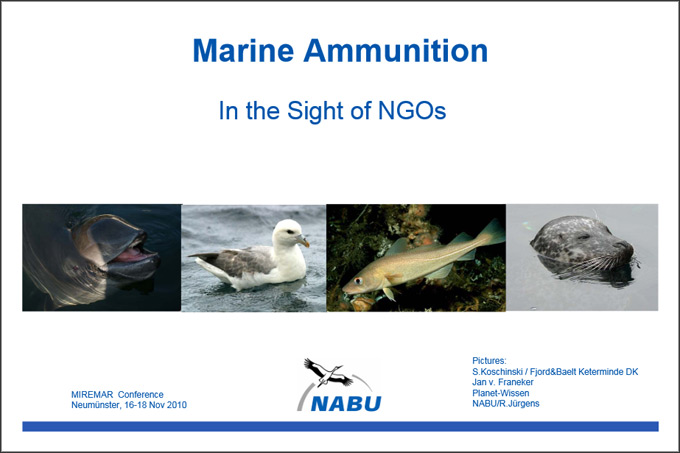
MIREMAR: Minimizing Risks for the Environment in Marine Ammunition Removal in the Baltic and North Sea
NABU, GRD, GSM: Conference Neumünster, Germany, 16. - 18. November 2010
Third International Dialogue on Underwater Munitions
from 14 to 15 April 2011 in Sopot/Poland
Upcoming Event:
Third International Dialogue on Underwater Munitions (IDUM)
from 14 to 15 April 2011 in Sopot / Poland
Please concider your participation!
MIREMAR - Lectures, Presentations, Results of Workshops, Media-Information
The Results of the Conference 2010 in Neumünster / Germany
MIREMAR - Lectures and all Presentations
Lectures and Presentations of the International Conference on Minimizing Risks for the Environment in Marine Ammunition Removal in the Baltic and North Sea (MIREMAR) 16th to 18th November 2010 in Neumünster, Germany
Mehr
MIREMAR-Workshops
Here we present the resulting papers of the workshops held on the MIREMAR-conference in Neumünster / Germany in the year 2010.
Mehr
Results of the MIREMAR-Conference
NABU, GSM and GRD held the International Conference on Minimizing Risks for the Environment in Marine Ammunition Removal in the Baltic and North Sea (MIREMAR) from 16th to 18th November 2010. These are the results in the sight of the organizers.
Mehr
Munition im Meer muss gehoben werden
NABU, GSM und GRD haben aus Anlass der MIREMAR-Konferenz eine Bergung und Beseitigung von Altmunition in Nord- und Ostsee gefordert. Von den Altlasten aus dem Ersten und Zweiten Weltkrieg geht durch freigesetzte Giftstoffe eine große Gefahr für Mensch und Meeresumwelt aus. Sprengmethoden schädigen das marine Ökosystem.
Mehr
International Conference on Minimizing Risks for the Environment in Marine Ammunition Removal in the Baltic and North Sea (MIREMAR)
The conference was held from
16th to 18th November 2010
in
Neumünster, Germany
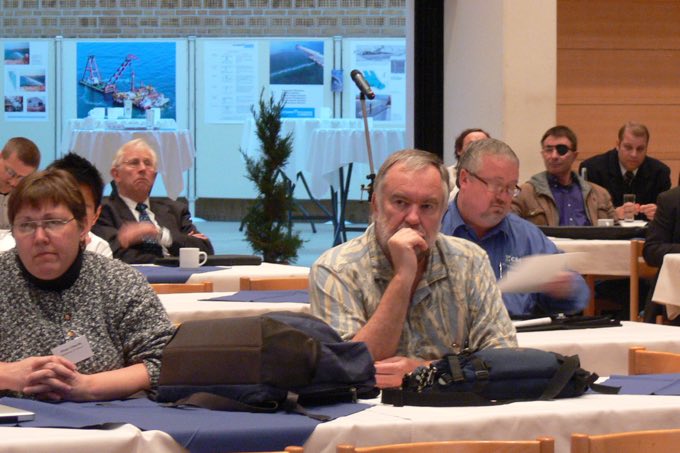
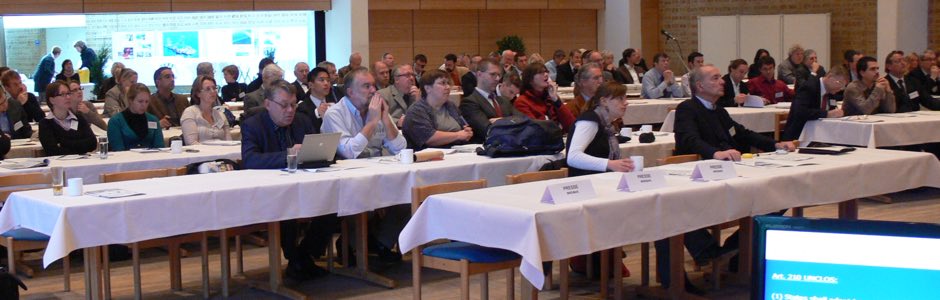
After theme sessions on Tuesday 16th and Wednesday 17th November (e.g., impact on biota, conventional treatment by blasting, recovery and removal of conventional ammunition, chemical warfare, political dimension) practical demonstrations, workshops and an excursion were offered on Thursday 18th November 2010.
If you have any questions, please contact Info@miremar.de
MIREMAR
Objectives | Co-operating Partners | Financial Support
OBJECTIVES
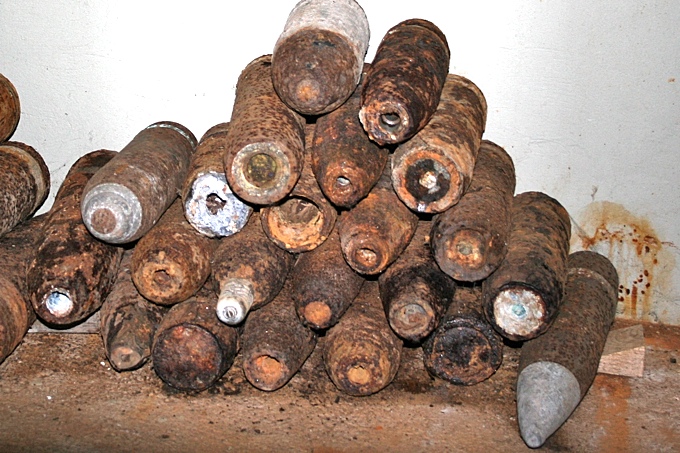
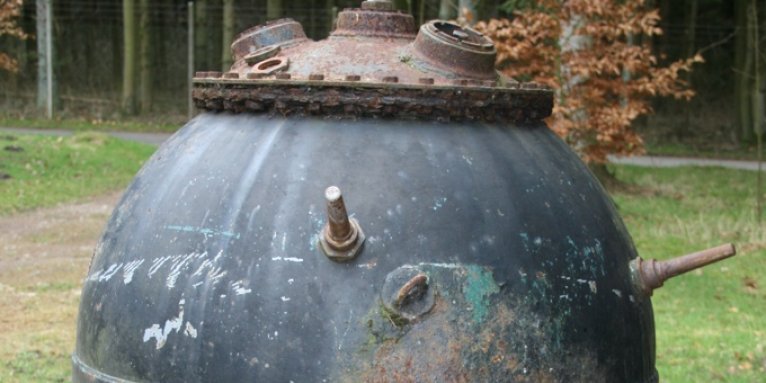
Large quantities of conventional ammunition (explosives) and chemical warfare have been deployed or dumped into Baltic and North Seas during and after World Wars I and II. It is still unclear what risks they pose to humans and the environment. The aim of the conference is to give an overview of the situation and actual developments in treatment of underwater unexploded ordnance. Identification of best practice and best available technique is a central objective of the conference. Workshops on the third day may help to establish a network of actors in order to initiate research, development or trials of new technologies.
| CO-OPERATING PARTNERS | |
|---|---|
![]() |
![]() Marine Services, UXB International, Canada |
![]() International Dialogue on Underwater Munitions, Canada |
|
| FINANCIAL SUPPORT: If you wish to become a sponsor of the conference please contact sponsoring@miremar.de | |
|---|---|
|
|
|
|
![]() |
|
MIREMAR: Tuesday, 16th November 2010
PROGRAMME: Registration | Introduction | Conventional Ammunition | Welcome Adresses | Detection | Dispersion of critical Substances
| REGISTRATION | INTRODUCTION | ||
|---|---|---|
| 8.00 | REGISTRATION | |
| TIME | AUTHORS | TITLE |
|
9.00 ![]() |
Monika Krivickaite, Walther-Schücking-Institute for International Law, Kiel / Germany: |
Legal Aspects of Conventional and Chemical warfare dumped in the sea |
|
9.30
|
Gunnar Möller, COM Mine Warfare Data Center (C MWDC), 4th Naval Warfare Flottilla, Berga / Sweden |
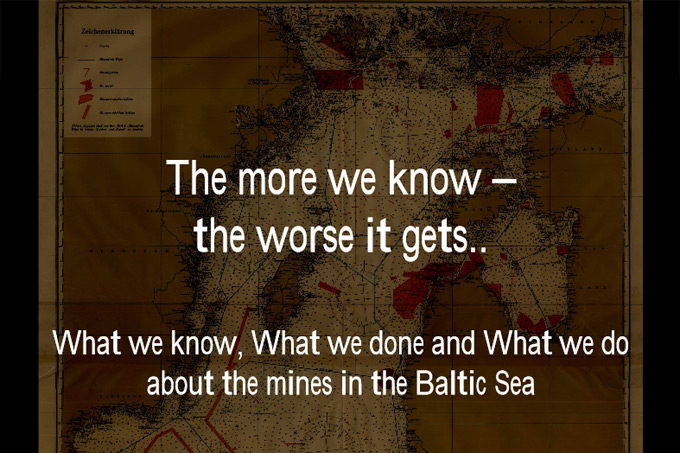
The More we know, the Worse it gets – on the Situation of Conventional Ammunition in the Baltic Sea |
|
10.00 - 10.30 |
COFFEE BREAK |
|
| TOPIC I: DETONATION OF CONVENTIONAL AMMUNITION | ||
|---|---|---|
| TIME | AUTHORS | TITLE |
|
10.30 ![]()
|
Lodewijk de Waard, Royal Netherlands Navy, Diving and Ordnance Disposal Group René Dekeling, Defense Materiel Organisation & Department of Transportation, Public Works and Water Management, The Hague / The Netherlands |
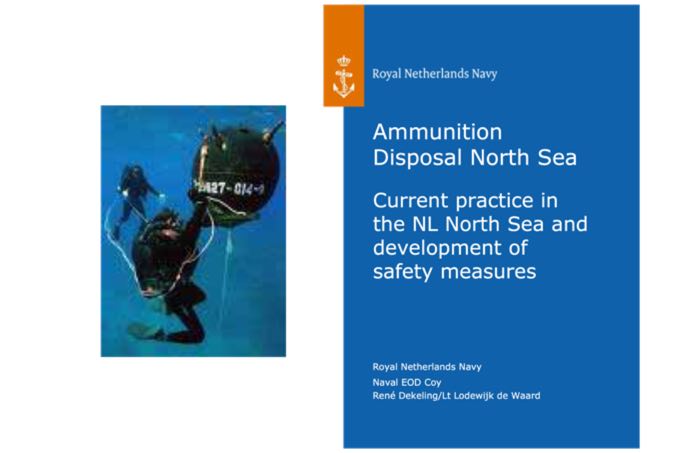
An overview of disposal of ammunition in the Dutch section of the North Sea: present practice and development of safety measures |
|
10.50 ![]() |
Sven Koschinski, Marine Zoologist, Nehmten / Germany |
Impact of Underwater Detonations on Marine Vertebrates |
|
11.10 ![]() |
Jens Sternheim, State Office for Civil Protection and Disaster Control, Kiel / Germany |
Removal of Conventional Ammunition in WW II Ammunition Dump Site „Heidkate“ (Kiel Bight) – Progress and Mitigation |
|
11.30
|
Tanja Grießmann, Institute of Structural Analysis, University of Hannover / Germany |
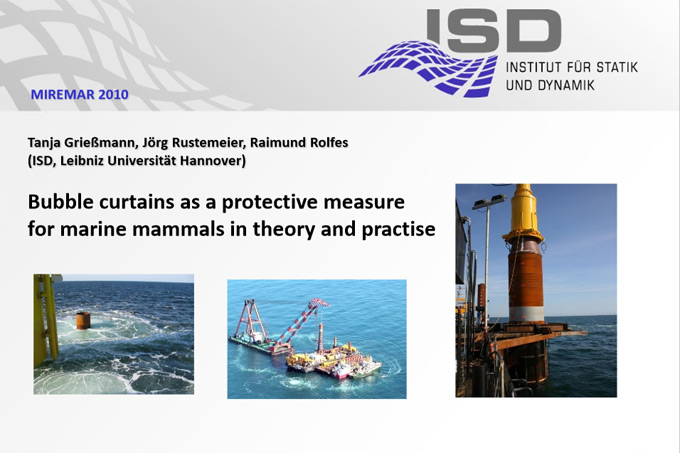
Bubble curtains as a protective measure for marine animals in theory and practice |
|
11.50
|
Edgar Schmidtke, WTD71 – Research Department for Underwater Acoustics and Marine Geophysics, Eckernförde / Germany |
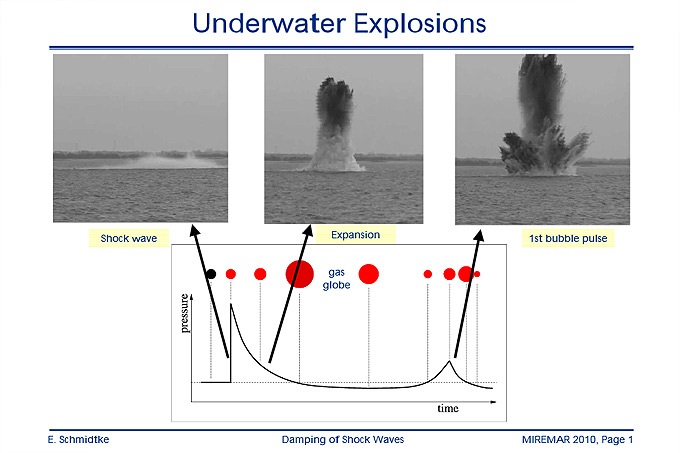
Damping of Shock Waves from Sea Mine Blasts to protect Marine Mammals – Results from Bubble Curtain Trials in Heidkate 2008 - 2010 |
|
12.10
|
Tiina Salonen, Environmental Manager Finland, Nord-Stream AG, Zug / Switzerland |
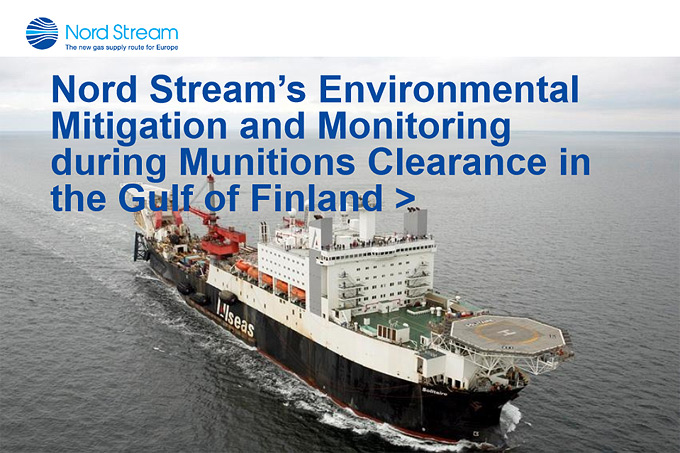
Nord Stream`s environmental mitigation & monitoring during munitions clearance in the Gulf of Finland |
| WELCOME ADDRESSES | DISCUSSION | ||
|---|---|---|
|
12.30 ![]() |
Dr. Johannes Merck, Presidium Nature and Biodiversity Conservation Union (NABU), Berlin |
|
|
12.45 |
Volker Dornquast, State Secretary for the Interior Schleswig-Holstein, Kiel |
|
| Due to time-related restraints the welcome addresses are not at the beginning. | ||
|
13.00 – 14.30 |
LUNCH BREAK |
|
| TOPIC II: DETECTION | ||
|---|---|---|
| TIME | AUTHORS | TITLE |
|
14.30
|
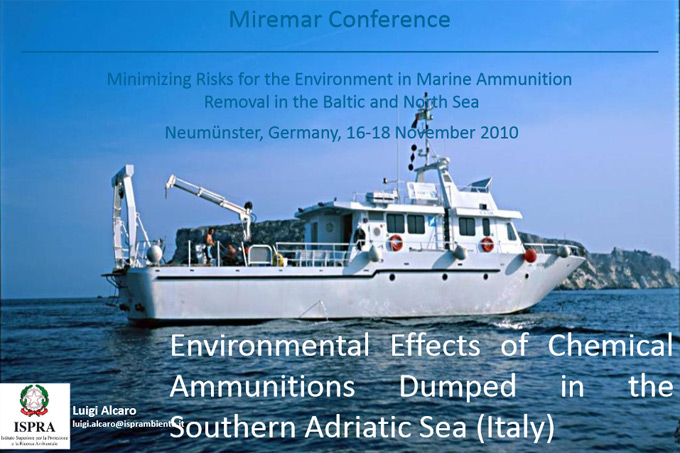
Luigi Alcaro, Institute for Environmental Protection and Research (ISPRA), Rome /Italy |
Electro-Acoustical Survey of Mean Apulian Harbours (Italy) to Find Dumped Ammunitions: a Proposal of New Methodology |
|
14.50 ![]() |
Thomas Wever, Federal Office of Defense Technology and Procurement, Koblenz / Germany |
Sediment Information in North and Baltic Seas – Relevant for Ammunition Detection |
|
15.10
|
Uwe Wichert, State Office for Civil Protection and Disaster Control, Kiel / Germany |
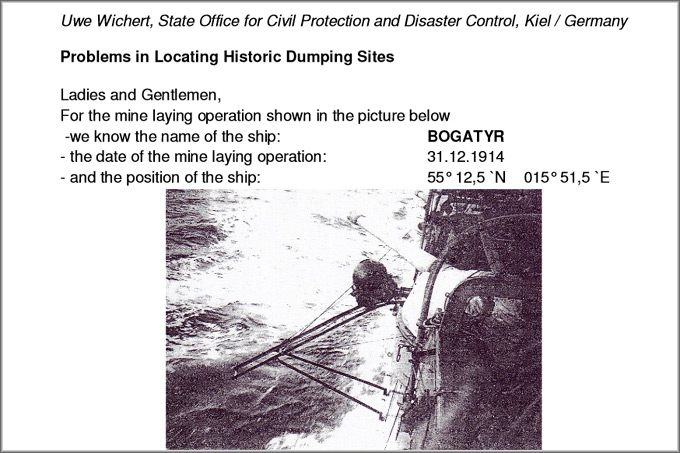
Problems in Locating Historic Dumping Sites – Examples from the Baltic Sea |
|
15.30 - 16.00 |
COFFEE BREAK |
|
MIREMAR: Wednesday, 17th November 2010
PROGRAMME: Press Conference | Conventional Ammunition | Chemical Warfare | Political Dimension
| PRESS CONFERENCE | TOPIC IV: RECOVERY OF CONVENTIONAL AMMUNITION | ||
|---|---|---|
|
9.30 - 10.00 ![]() |
PRESS CONFERENCE Press Officer Kathrin Klinkusch, NABU, Berlin |
|
| TIME | AUTHORS | TITLE |
|
8.30
|
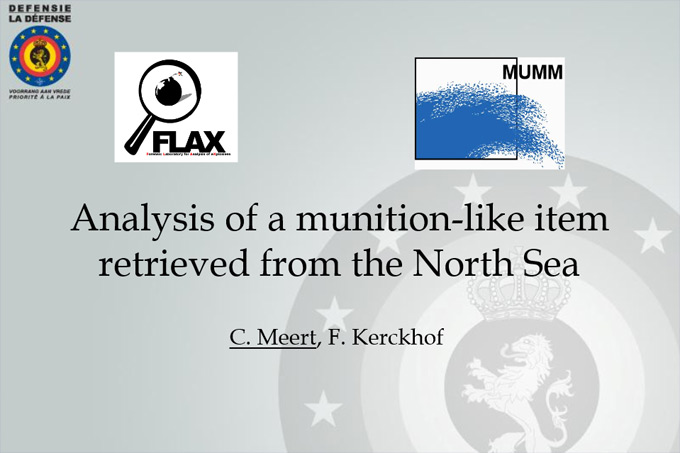
Christel Meert, Royal Military Academy, Dept of Chemistry, Brussels / Belgium (Co-author: Francis Kerckhof) |
Analysis of a Munition-like Item Retrieved from the North Sea |
|
8.50
|
Franz Eder, ANT AG, Lübeck / Germany |
Recovery of conventional Marine Ammunition using Salvage Robots and Water Abrasive Suspension Jet Cutting (See also: Practical Demonstration on 3rd Day of the Conference) |
| 9.10 | Frank Bargmann, Séché global solutions / UTM GmbH, Lübeck / Germany | Recovery and Safe Transport of Chemical and Conventional Marine Ammunition Using Salvage Robots and Explosion Proof Reactors |
|
9.30
|
Fritz Pfeiffer, Office for Environmental Geology & Security Research, Marburg / Germany |
Photolytic Treatment of Explosives using Sunlight, a possible Solution for Heidkate Ammunition Dump? |
|
9.50
|
Erika Brandenburg, Concurrent Technologies Corp. Jacksonville / USA |
Parameters for Selecting a Munitions Recovery Technology |
|
10.10 - 10.50 |
COFFEE BREAK |
|
| TOPIC V: CHEMICAL WARFARE | ||
|---|---|---|
| 10.50 | John Hart, Chemical and Biological Security Project, Arms Control and Non-proliferation Programme SIPRI Solna /Sweden | An Overview of Historical, Political and Environmental Aspects of Chemical Warfare |
|
11.15 ![]() |
Jonathan Mills, OPCW, The Hague, The Netherlands |
Sea Dumped Chemical Weapons - The Scope and Purpose of the Chemical Weapons Convention |
|
11.40
|
Thomas Stock, Dynasafe Germany GmbH, Mülheim / Germany |
Destruction of Old Chemical Weapons – Technologies under Application |
|
12.00
|
Luigi Alcaro, Institute for Environmental Protection and Research (ISPRA), Rome /Italy |
Environmental Effects of Chemical Ammunitions Dumped in the Southern Adriatic Sea (Italy) |
| 12.20 |
Nadezda Medvedeva, Scientific Research Centre for Ecological Safety Russian Academy of Sciences, St. Petersburg / Russia (Co-authors: Yulia Polyak, Tatyana Zaytseva, Irina Kuzikova) |
Microbial responses to chemical weapons dumped in the Baltic Sea |
|
12.40
|
Vadim T. Paka, Atlantic Branch, P. P. Shirshov Institute of Oceanology, Russian Academy of Sciences, Kaliningrad, Russia |
Clean-up of the Bornholm CW Dumpsite: Towards the Optimum Decision |
|
13.00 |
LUNCH BREAK |
|
|
14.30 ![]() |
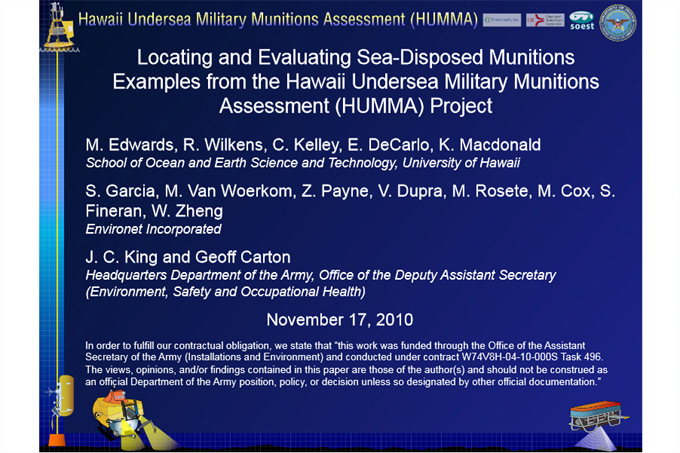
Margo Edwards, School of Ocean and Earth Science and Technology, University of Hawaii, Honolulu,Hawaii / USA (Co-authors: Roy Wilkens, Christopher Kelley, Eric DeCarlo, Kathryn Macdonald, Sonia Garcia, Michael Van Woerkom, Zachary Payne, Vilma Dupra, Matt Rosete, Miya Cox, Stacey Fineran, Weixi Zheng, J. C. King and Geoff Carton) |
Locating and Evaluating Sea Disposed Munitions - Examples from the Hawaii Undersea Military Munitions Assessment (HUMMA) Project |
MIREMAR: Thursday, 18th November 2010
PROGRAMME: Demonstrations | Workshops | Excursions
DEMONSTRATIONS / WORKSHOPS / EXCURSION
9.00 - PRACTICAL DEMONSTRATIONS (outside of the conference building)
- Water Abrasive Suspension (WAS) cutting (ANT Applied New Technology AG, Lübeck/Germany)
Workshops
10.00
DATABASES
Good environmental information of a site has a large influence on search success, information on condition of shells and critical substances and influence on the marine environment. Site chemistry (and changes thereof) and substances involved are an important factor in monitoring operations. Databases can provide such information. Further, data on protected areas or species can be included into databases. How does existing position data have to be preprocessed? How can existing databases be combined? What can be achieved by filtering of data? How can environmental issues be integrated into existing priority systems? These and other questions can be addressed during the workshop.
COMBINATION OF TECHNICAL SOLUTIONS, FROM DETECTION TO REMOVAL
Best available treatment technique may require concerted action by a number of actors. Off-the-shelf techniques barely exist. Underwater vehicles, sensors, cutting, recovery, destruction and/or remediaton techniques must be compatible in order to get the best results. This workshop provides the opportunity to meet and discuss technical details of how different systems could be integrated into one strategy.
MITIGATION OF SHOCK WAVES FROM DETONATIONS
Shock waves from underwater blasts are a danger for marine mammals, diving birds and fish. However, in some cases it may for safety reasons not be possible to avoid detonations. One method to reduce the shock wave of detonations is the use of bubble curtains. How can the efficiency of a bubble curtain be improved? Are there other methods such as directing the energy? Can the elasticity of the sea-floor surface or structural modifications on an electrochemical basis be used as a damping element? - If you have an interest in physics of underwater detonations, this may be your workshop.
CHEMICAL DMM – STILL A WMD THREAT?
Due to their toxic fillings DMM do not become inert as time passes by. But is there any realistic threat as these compositions are of special interest to certain organisations?
Do really old sea-dumped DMM´s retain the capability to act as WMD? Are they still applicable to smaller targets or even single event point attacs? As the combination with conventional IED´s is feasible, what is to be anticipated as a result? What knowledge is available? What are the requirements for cladestine recovery, reclamation and use of chemical DMM payloads? What is the political impact with respect to critical infrastructures, high value targets and reconnaissance and countermeasures?
10.15 – 13.45 EXCURSION
Excursion to Explosive Ordnance Disposal „Groß Nordsee” near Kiel Canal.
17.00 END OF CONFERENCE
Organizers and Participants
Organisations - who is who
SYMPOSIUM ORGANIZERS
Sven Koschinski, Ingo Ludwichowski, Kim Detloff & Nikola Vagt
SYMPOSIUM HOSTED BY
Nature and Biodiversity Conservation Union (NABU Schleswig-Holstein)
Färberstr. 51, 24534 Neumünster
Society for the Conservation of Marine Mammals GSM
Kieler Straße 2, 25451 Quickborn
Society for Dolphin Conservation Germany GRD,
Kornwegerstr. 37, 81375 München
First Conference on Ammunition Removal 2007
Symposium ''New Methods of Ammunition Removal in the North and Baltic Sea''
The main reason for the continuous decrease of harbour porpoise population are the set nets of the fishing industry. But also high sound pressure and explosion related shock waves of ammunition explosions can lead to severe injuries and hearing impairment for marine mammals. At the symposium, NABU, GSM and GRD brought together information about new methods of ammunition removal.
Mehr
Ihre Hilfe für Schweinswal und Co.

NABU Regional
Service
E-Cards
Podcasts
Ab sofort gibt es den NABU zum Hören. Vogelstimmen, Musik und Interviews machen den Podcast zu einem wahren Vergnügen fürs Ohr.
Desktopmotive
Verbandsnetz
„Betrifft: Natur“, April 2012
Das NABU-Magazin als Download Mehr
Minimizing Risks for the Environment in Marine Ammunition Removal in the Baltic and North Sea MIREMAR
NABU, GRD, GSM: Conference Neumünster, Germany, 16. - 18. November 2010 Mehr
Kindergeburtstag mal anders feiern
Der Geburtstag steht bevor, doch noch keine Idee, was man mit den Kindern machen kann? Die Antwort: Der NAJU-Naturgeburtstag! Mehr
Umweltethik
Vom Eigenwert der Natur: Broschüre jetzt herunterladen! (0,9 MB) Mehr
NABU-Aktion: Europa sagt Nein zur festen Beltquerung!
Machen Sie mit - Helfen Sie unseren Zugvögeln! Mehr
Vogel des Jahres 2012
Die Dohle ist Vogel des Jahres 2012. Erfahren Sie mehr über einen bedrohten Bewohner unserer Dörfer und des Grünlands. Mehr
Wer ist schon da?
Beobachten Sie tagesaktuell die Fledermaus- Aktivitäten in der Segeberger Kalkberghöhle! Mehr